Foreword
“
The organizations that treat this Almanac as a call to disciplined action will be the ones that maintain trust when it matters most.
Lt. Gen. Mark E. Weatherington, USAF (Ret.)
Foreword to The Quantum Almanac 2026-2027Signal over noise on quantum risk to data security
2026 - 2027
A decision-oriented resource guide for boards, CISOs, architects, and investors navigating quantum risk, trust architecture, and post-quantum readiness.
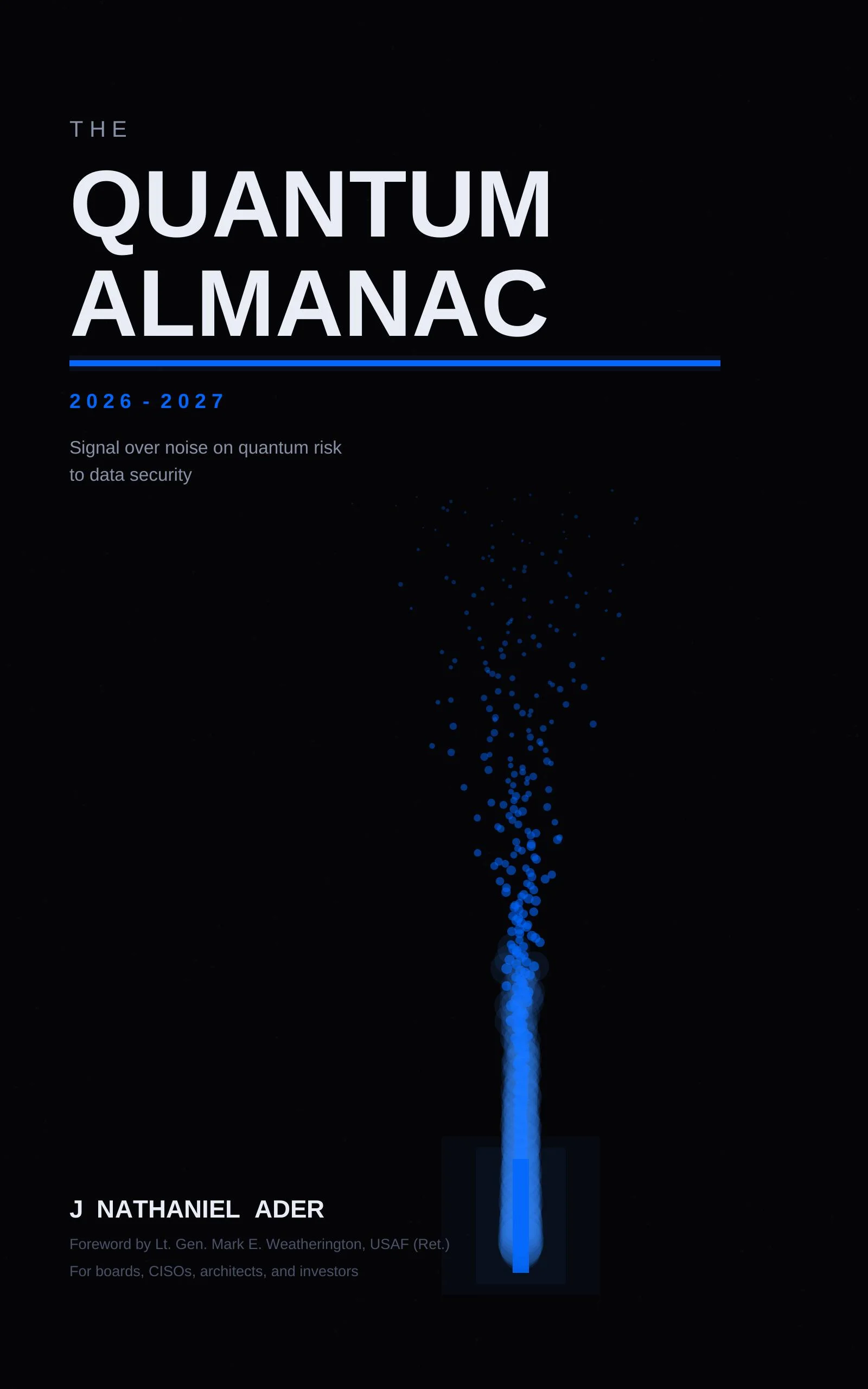
The Quantum Almanac 2026-2027 by J. Nathaniel Ader is a decision-oriented resource guide on quantum risk, covering harvest now decrypt later threats, post-quantum cryptography migration, and trust architecture for boards, CISOs, architects, and investors. Published by Qtonic Quantum Corp with a foreword by Lt. Gen. Mark E. Weatherington, USAF (Ret.). Available in hardcover ($99.99) and Kindle ($9.99) on Amazon. ISBN 979-8250257756. Hardcover on sale on Amazon since March 4, 2026 (Kindle edition March 5); launched March 10, 2026.
Why this book now
Central banks, G7 coordination, national cyber guidance, public procurement language, and production platform defaults shifted the topic from abstract debate into planning, governance, and execution.
Evidence over hype
Weights central-bank analysis, standards work, national guidance, public procurement language, and platform defaults above vendor theater.
Current through February 28, 2026
The scope is explicitly bounded to a fixed date, which improves trust and makes the thesis auditable instead of slippery.
Operational, not speculative
Treats quantum risk as trust-governance and migration timing, not as a physics prediction contest.
Who this is for
Boards and audit committees that need a direct explanation of what changes now and what can wait.
CISOs and security architects mapping PKI, software signing, long-lived data, and trust dependencies.
Investors, operators, and advisors who need evidence-weighted signal instead of futurist noise.
What you get
20 chapters plus 11 appendices built for action, not abstract awareness.
A threat model that starts with harvest now, decrypt later instead of vague timeline guessing.
Operational treatment of procurement, PKI, machine identity, backups, archives, and board communication.
A board briefing kit, procurement workbook, maturity model, and 12-month action plan.
What this book is not
Not a Q-Day prediction.
Not a vendor endorsement.
Not a call for panic spending.
It is a migration-governance manual for institutions that hold long-lived trust.
Inside the book
Board briefing kit, procurement workbook, vendor scoring tools, readiness maturity model, sector implementation roadmaps, case studies, glossary, and primary source quick reference.
Each chapter stands on its own. Choose the path that matches your role.
Board and investor track
Preface, Executive Summary, Changes from 2025-2026 Edition, Chapters 1, 6, 8, 18, 19, and 20, then Appendix B.
A compact path for governance, disclosure, capital allocation, and oversight.
CISO and architect track
Executive Summary, Changes from 2025-2026 Edition, Chapters 2, 4, 7, 9 through 13, 15 through 17, Appendix C, and Appendix J.
Designed to move quickly from threat model to inventory, trust, supplier pressure, and implementation.
Look inside
Front matterLetter to the Reader
If you picked up this book with one eyebrow raised, you are not the wrong reader. You are exactly the reader this section is for.
Most serious people do not come to quantum risk through a calm chain of evidence. They come to it through a headline, a vendor deck, a passing mention in a board packet, or a meeting where someone says, “We should probably watch this.” That is a bad way to develop judgment. It creates either panic or dismissal. Neither one helps you.
So let me level with you directly.
No honest person can tell you the date on which a cryptographically relevant quantum computer will arrive. No honest person can promise which vendor roadmaps will mature on schedule. No honest person can tell you that every part of the standards and implementation landscape will feel clean and settled next quarter. If someone is selling certainty here, be careful.
But uncertainty about the date is not the same thing as uncertainty about the work.
Formats and availability
Equip your team
Volume pricing available for teams of 10+. Contact us for institutional and conference bulk orders.
Inquire about bulk pricingStay informed
What you get: next-edition updates, new analysis from the evidence base, and volume pricing for teams. Occasional e-mails only.
Used only for book updates. Privacy notice.
Companion deck
The companion presentation deck compresses 204 pages into 45 boardroom-ready slides. Every chapter becomes one slide. Key frameworks are rendered as visual tools your team can use immediately.
About the author
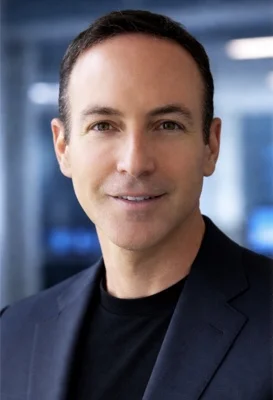
Foreword by Lt. Gen. Mark E. Weatherington, USAF (Ret.)
Author of The Quantum Almanac 2026-2027. Co-Founder and Chief Innovation Officer of Qtonic Quantum Corp, founder of Qtonic Quantum Lab, and builder of QScout and QStrike.
Full author bioCommon questions
A decision-oriented resource guide on quantum risk, trust architecture, and post-quantum readiness for boards, CISOs, architects, and investors.
Quantum risk is a lead-time problem. The hard part is migration, inventory, and governance, not just predicting a breakthrough date.
It uses an evidence hierarchy grounded in official guidance, standards, procurement language, and production platform behavior rather than broad futurist claims.
The Quantum Almanac 2026-2027 went on sale on Amazon on March 4, 2026 (hardcover; Kindle March 5) and launched publicly on March 10, 2026.
The book is available in a $99.99 glossy hardcover edition and as a Kindle edition on Amazon.